/WORK/CELL-MIGRATION-SEGMENTATION
Comparing segmentation methods for cell migration
A Python framework and desktop app comparing classical and deep learning segmentation, evaluated across five complete microscopy clips.
- Period
- 2025/26
- Related module
- COMP3200: Part III Individual Project
Python · PyTorch · OpenCV · NumPy · SciPy · PyQt5
What I built
I built a Python framework and desktop application to compare two ways of finding cell outlines in microscopy footage. U-Net achieved higher overall overlap with the reference masks, but a classical thresholding pipeline performed better on the clip recorded with a different microscope. Looking at that reversal was more useful than reporting a single winner.
The work brought together image processing, neural-network training, dataset annotation, experimental evaluation, and a PyQt5 demonstrator. It was my third-year individual project for COMP3200 at the University of Southampton.
The research question
I investigated whether a constrained image-analysis problem needs a neural network, using microscopy footage of single breast cancer cells squeezing through microfluidic channels. The background stays mostly fixed, which should help classical methods, but the cell can deform into thin, irregular shapes that are difficult to separate from the walls.
The comparison used an Otsu thresholding pipeline and a U-Net. The work was supervised by Prof. Dimitra Georgiadou. Dr. Rosalia Moreddu, the project’s original supervisor, supplied the microscopy footage from existing experiments.
Building the comparison
I curated 2,274 image–mask pairs across five clips. A SAM3-assisted annotation tool proposed masks, followed by cleanup and manual review in napari. This reduced the manual annotation work, but did not make every reference mask unambiguous: phase-contrast halos, contact with channel walls, and thin cell extensions could obscure the boundary.
The two segmentation methods use different preprocessing because they need different information:
- Otsu thresholding estimates and subtracts a static background, enhances contrast, and cleans the thresholded mask with closing, hole filling, and opening. It then keeps the largest connected component, relying on the single-cell setting.
- U-Net uses lighter preprocessing to retain image detail, followed by a PyTorch encoder–decoder network with skip connections. Training combines Dice and binary cross-entropy loss, paired image–mask augmentation, dropout, and validation-based early stopping.
For the network, I resized frames while preserving their aspect ratio and padded them to a square, then reversed that operation for the output. Stretching a cell to fit a square input would change the very shape the system was meant to measure.
One interface for experiments and the application
Each method implements a common segmentation interface. A SegmentationPipeline facade handles
the method’s preprocessing, background estimation, and model loading, so callers do not need to
rebuild that wiring. The same framework supports the experiment scripts and the GUI.
The released core exposes the same workflow. This abbreviated example shows how a loaded clip
becomes masks and measurements; frames and frame_rate come from the input clip:
from cell_segmentation import SegmentationPipeline

pipeline = SegmentationPipeline.create("threshold")
masks = pipeline.segment_clip(frames)
measurements = pipeline.extract_kinematics(masks, frame_rate=frame_rate)
pipeline.save_kinematics_csv(measurements, "kinematics.csv")
The U-Net uses the same operations after construction with "unet" and a path to trained
weights. Adding a method requires an implementation of the shared interface and an entry in the
method registry.
The PyQt5 demonstrator loads a video or folder of frames, runs either method, and shows raw, preprocessed, and segmented views side by side. A frame scrubber and metrics strip make it possible to inspect individual results. Processing runs in a worker thread to keep the interface responsive; export writes predicted masks and a CSV of position, shape, and movement measurements.
Evaluating on unseen clips
Neighbouring video frames are very similar. Randomly splitting them into training and test sets could make a model look successful while mainly testing footage it has effectively already seen. I used leave-one-clip-out cross-validation instead: each complete clip becomes the test set once. For each U-Net fold, three other clips provide training data and one provides validation data for checkpoint selection. The held-out test clip is used for evaluation.
I measured both Dice overlap and 95th-percentile Hausdorff distance (HD95), a boundary-distance measure. Overlap alone can hide errors in thin cell extensions.
Results: the ranking changed with the microscope
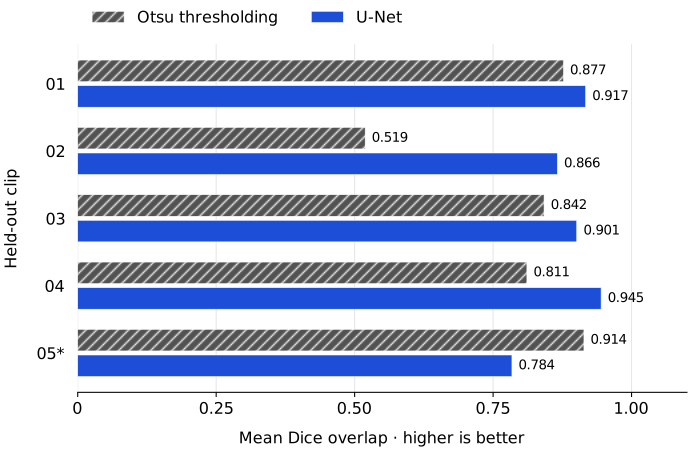
The five clips contained 300, 375, 500, 497, and 602 frames respectively. These are the reported mean results; higher Dice and lower HD95 are better:
| Test data and metric | Threshold | U-Net |
|---|---|---|
| All clips: Dice ↑ | 0.806 | 0.876 |
| All clips: HD95 (px) ↓ | 93.9 | 61.3 |
| Clip 01: Dice ↑ | 0.877 | 0.917 |
| Clip 02: Dice ↑ | 0.519 | 0.866 |
| Clip 03: Dice ↑ | 0.842 | 0.901 |
| Clip 04: Dice ↑ | 0.811 | 0.945 |
| Clip 05: Dice ↑ | 0.914 | 0.784 |
U-Net performed better overall, but the ordering changed on clip 05, which came from different microscope conditions. Thresholding benefited from its cleaner background, while the held-out clip exposed a change in imaging appearance that the network had not learned from its training clips. This is evidence for keeping a classical baseline in this setting, rather than a general claim that thresholding handles every microscope change better.
The comparison includes the whole processing pipeline. Thresholding estimates a background from the unlabelled input clip, while U-Net learns from the training clips and does not use that background-subtraction step. The result compares those practical workflows, rather than isolating the segmentation algorithm from its preprocessing.
Looking at failures
The methods failed in different ways. Thresholding could retain channel-wall debris and select the wrong foreground region. U-Net could produce uncertain boundaries or disconnected false regions. On clip 03, its higher mean Dice accompanied a worse mean HD95, illustrating why one summary score was insufficient.
The desktop viewer and comparison figures helped connect these numerical results to individual frames. They also made the downstream consequences clearer: an outline error changes perimeter, circularity, and solidity as well as the segmentation score.
Limits and lessons
Five clips are a small basis for generalisation. The 2,274 frames are temporally correlated, rather than 2,274 independent biological experiments. Frame-level statistical tests therefore need that qualification, and the per-clip results are more useful than a very small headline p-value. The reference annotations also contain uncertainty, and the study compares only one classical pipeline and one U-Net implementation.
The most useful result was identifying when the methods exchanged places. A stronger overall average did not remove the need to examine unfamiliar imaging conditions or difficult individual frames. The project also taught me to make assumptions about image shape, bit depth, and foreground geometry explicit before those assumptions became silent processing errors.
I prioritised segmentation, evaluation, and per-frame kinematics over adding a separate identity tracker. More varied footage, independent annotation checks, and additional segmentation baselines would be the next steps. The application is a research demonstrator; the project did not establish clinical usefulness or validate its measurements for medical decisions.
Source code
Cell Migration Framework on GitHub contains the reusable backend and a synthetic example under the MIT licence.